Crafting the Immersive Whale Interior for "Whalefall"
Bringing a Leviathan's Belly to Life: The Art of Immersive Filmmaking
The Enclosed World: Designing the Whale's Inner Chambers
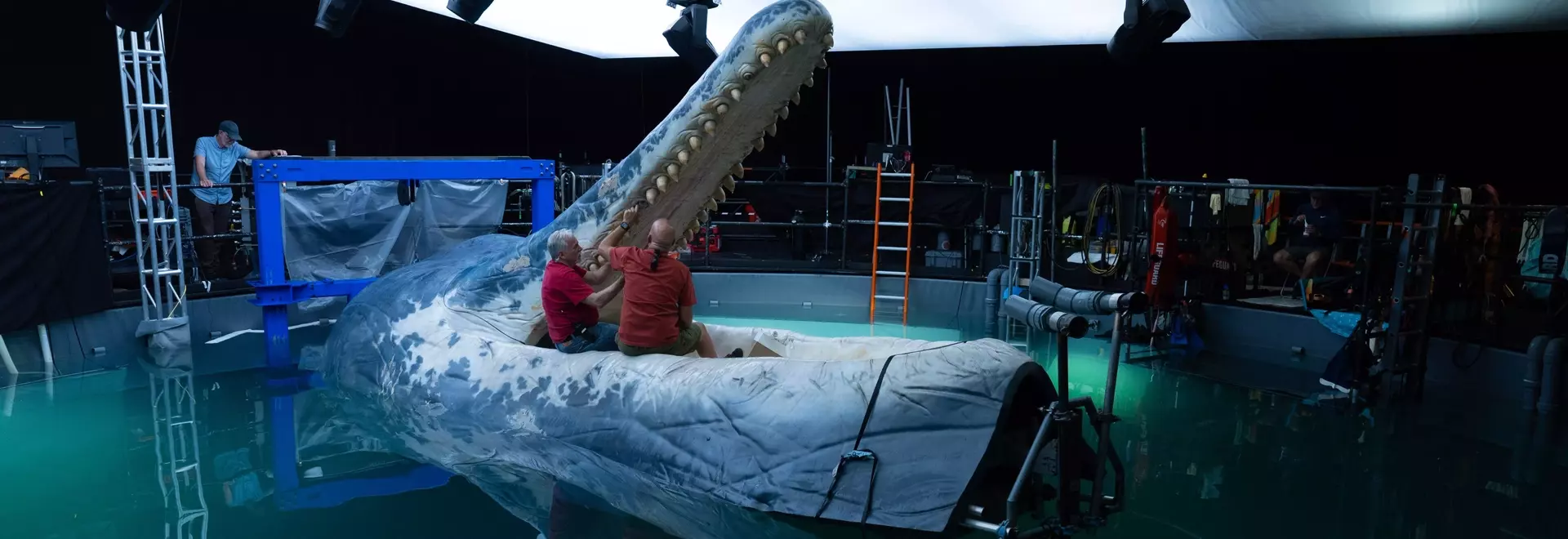
In the cinematic adaptation of Daniel Kraus's gripping novel "Whalefall," the protagonist Jay Gardiner, portrayed by Austin Abrams, endures the harrowing experience of being swallowed by a colossal sperm whale. Production designer Ramsey Avery, alongside the film's creators, embarked on an ambitious endeavor to render this dire predicament with an unparalleled sense of realism. Their approach involved the meticulous construction of a substantial 35-foot whale head and a series of four distinct stomach environments. These sets were engineered to permit dynamic movement, allowing for climbing, jostling, and even being filled with a simulated digestive fluid. This hands-on methodology ensured that actor Austin Abrams's physical reactions to his surroundings were genuinely authentic, as all on-screen motion stemmed from practical effects rather than digital animation.
Dynamic Environments: Simulating the Internal Organism
To replicate the turbulent conditions inside a whale, the design team devised ingenious mechanical systems for the sets. One stomach replica was mounted on a specialized rig, enabling a rocking motion, while another was housed within a cylindrical structure, reminiscent of a washing machine, to violently toss the actor. A third set, built upon a seesaw mechanism, could be tilted to drench Abrams in methylcellulose, a concoction designed to mimic corrosive stomach acid. The menacing giant squid, which ensnares Jay in the whale's mouth, was brought to life through sophisticated puppetry. These handcrafted tentacles, some reinforced with wires and others containing internal mechanisms for writhing, could physically encircle Abrams's neck and head, providing a tangible element for the camera, with visual effects later enhancing their fluid, squid-like movements.
Conquering the Elements: Managing Water on Set
The throat of the whale set was ingeniously crafted from porous, antibacterial foam to prevent mold growth, a critical consideration given the extensive use of liquids. To manage potential flooding on set, oversized children's pools were strategically deployed. Avery emphasized the inherent challenges of integrating water into film production, describing it as an exceptionally difficult element to control, far more capricious than snow. Water, by its very nature, follows its own course, defying precise manipulation. This constant battle against an unpredictable force highlighted the complexities of achieving the desired visual and tactile effects within the confines of a controlled studio environment.
Scientific Precision: The Foundation of Biological Accuracy
The filming process itself was an exercise in claustrophobia, with Abrams, two cameras, a sound boom, and a puppeteer crammed into a compact six-by-eight-foot space. Visual effects supervisor Guillaume Rocheron digitally augmented the scene with additional tentacles to compensate for the physical limitations of the set. The dimensions of the internal whale environment were rigorously based on scientific measurements of an 80-foot sperm whale, derived from observations of beached whales. This scientific grounding extended to the scale testing of the squid, ensuring its size was appropriately proportioned to interact convincingly with an actor of Austin's stature within the simulated stomach.
Expert Collaboration: Marine Biology Meets Moviemaking
During the set's construction in New Zealand, Avery engaged in extensive consultations with Dr. Joy Reidenberg, a distinguished comparative anatomy research scientist specializing in marine mammalogy. Through early morning Zoom calls, Dr. Reidenberg guided Avery and his team through detailed explanations of whale dissections she had performed, offering invaluable insights into their physiological mechanics. Her expertise was instrumental in the precise construction of a six-foot whale tongue and the formidable teeth that Jay attempts to scale in his desperate bid for escape. This collaboration underscored the commitment to scientific accuracy that permeated the film's design.
Illuminating Details: Crafting Bioluminescent Effects
Further scientific consultation involved marine biologist Dr. Steve Haddock, an expert in bioluminescence, who advised on the design of the glowing jellyfish Jay utilizes to navigate the whale's dark interior. Dr. Haddock recommended three species capable of providing the requisite illumination, from which Avery's team selected one that could be comfortably held in Jay's hand. The prop itself was fashioned from silicone and incorporated a programmable LED, allowing it to flicker convincingly as Jay struggled to keep the creature alive. This intricate detail, born from scientific advice, added another layer of authenticity to the film's visual narrative.
Improvisational Storytelling: On-Set Creative Decisions
Avery revealed that a significant portion of the film was not meticulously storyboarded due to the ever-evolving nature of the set. He and director of photography Aaron Morton would immerse themselves within the constructed sets or their mock-ups, capturing photographs to determine the desired sequence of shots. These on-set explorations effectively became the film's organic storyboards, reflecting a dynamic and responsive creative process. This flexible approach allowed for spontaneous adjustments and innovations, ensuring that the evolving environment dictated the narrative flow rather than being rigidly confined by pre-conceived plans.
Actor Immersion: Austin Abrams's Dedicated Preparation
Austin Abrams undertook extensive preparation for his demanding role, beginning with acquiring scuba diving certification and embarking on a trip to the Caribbean to swim alongside sperm whales. While a stunt double was utilized for certain sequences, Abrams personally executed the majority of the diving scenes. His training included navigating kelp forests near California's Catalina Island and ascending an underwater cliff constructed within a massive tank, measuring 60 feet wide and 25 feet tall. This deep personal immersion by the actor contributed significantly to the raw authenticity of his performance.
Overcoming Obstacles: The Art Department's Perseverance
The comprehensive process of set construction and filmmaking spanned nine months, a period during which Avery frequently encountered sleepless nights grappling with various production challenges. These included devising methods to prevent paint from detaching from props submerged in chlorinated water, a problem ingeniously solved by dyeing moss, and finding sufficient space to film Abrams tumbling within the tank, which was achieved using a hydraulic lift to create the illusion of accelerated movement. Avery acknowledged the immense difficulty of the undertaking but emphasized that the film's success hinged on the believability of the whale's interior, providing an essential environment for Austin's compelling performance. He concluded by highlighting the importance of leading the art department with both enthusiasm and respect, fostering a creative atmosphere conducive to overcoming such formidable obstacles.