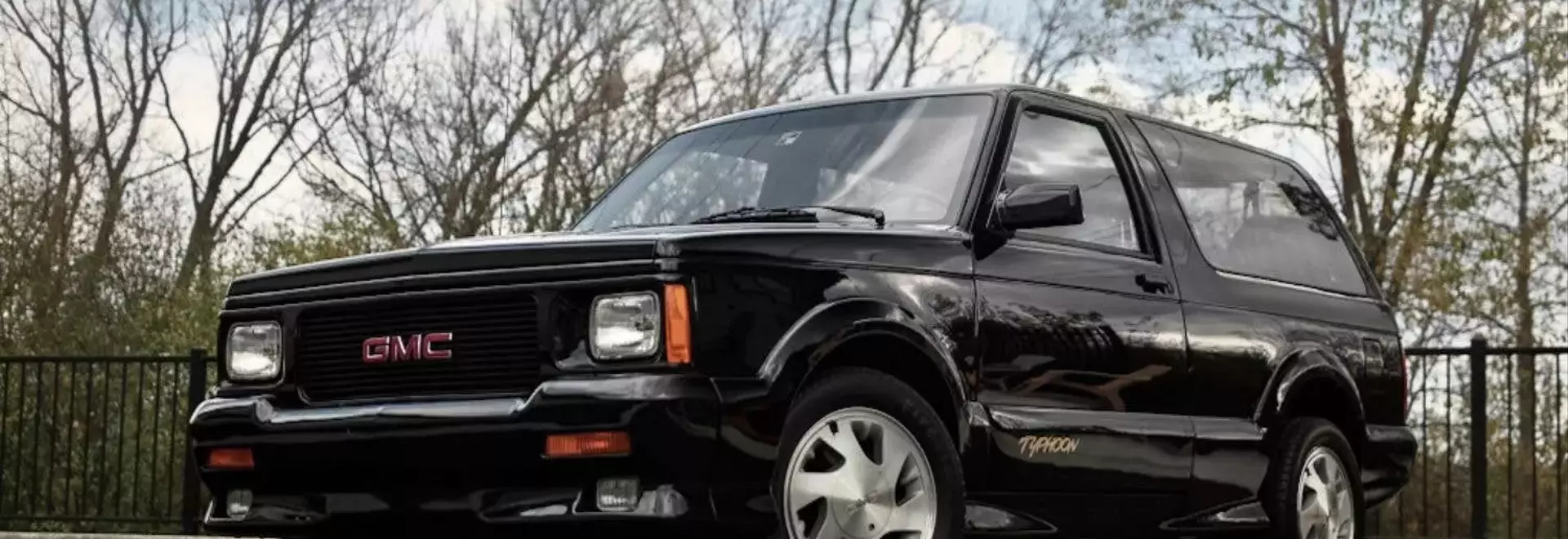
The GMC Typhoon: A Precursor to High-Performance SUVs
In the early 1990s, when the concept of a high-performance sport utility vehicle was virtually nonexistent, GMC boldly introduced the Typhoon. This remarkable vehicle, capable of accelerating from 0 to 60 mph in a mere 5.3 seconds, was a visionary creation that predated the modern surge of luxury performance SUVs from European manufacturers. Building upon the engineering prowess demonstrated by its predecessor, the Syclone pickup, the Typhoon proved that a practical, family-oriented vehicle could also deliver exhilarating speed and handling. Though its production numbers were modest, the Typhoon's impact was profound, challenging conventional automotive norms and laying the groundwork for a new segment of vehicles that would eventually redefine performance and utility. It remains a testament to American automotive innovation, a true pioneer in the world of fast SUVs.
Pioneering Performance: The Genesis of the GMC Typhoon
In 1992, General Motors' GMC division, in collaboration with Production Automotive Services (PAS), unveiled a revolutionary vehicle that would forever alter the automotive landscape: the GMC Typhoon. This groundbreaking SUV, developed from the S-15 Jimmy platform, was a direct descendant of the acclaimed 1991 GMC Syclone pickup, which had already demonstrated the potential for truck-based vehicles to achieve sports car-rivaling performance. The Typhoon was engineered to combine the practicality of an SUV with the thrilling acceleration typically found in high-end sports cars.
The heart of the Typhoon was a highly modified 4.3-liter LB4 V6 engine. Starting with a base of 160 horsepower, PAS meticulously enhanced it with a Mitsubishi TD06 turbocharger, operating at 14 psi of boost, and a Garrett Water/Air intercooler. Additionally, components from the small-block 350 V8 were integrated to optimize performance. This sophisticated powertrain delivered an impressive 280 horsepower and a robust 360 lb-ft of torque, a significant increase over its standard counterparts. To manage this power, the Typhoon featured a unique all-wheel-drive system with a 35:65 power split, biased towards the rear for enhanced driving dynamics. The vehicle's suspension was also thoroughly re-engineered; it was lowered and stiffened for superior cornering ability, complemented by a rear air-suspension system and larger brakes, along with a limited-slip differential at the rear, transforming it into a true road-hugging machine rather than an off-road utility vehicle.
Weighing approximately 3,822 pounds—lean for an SUV of its era—the Typhoon's power-to-weight ratio, combined with its advanced all-wheel-drive traction, resulted in astonishing performance figures. Contemporary tests by "Car and Driver" reported a 0-60 mph acceleration time of just 5.3 seconds, a quarter-mile completed in 14.1 seconds at 95 mph, and an impressive skidpad rating of 0.79g. These numbers were not only exceptional for an SUV but also allowed the Typhoon to outperform many prestigious sports cars of the time, including the Ferrari 348ts, BMW M5 (E34), and Porsche 968, while maintaining pace with vehicles like the Acura NSX and Chevrolet Corvette LT1. Priced at $29,530, it offered an accessible entry into elite performance.
Despite its stellar performance and pioneering spirit, the GMC Typhoon had a limited production run, with only 4,697 units built. Nevertheless, its legacy as a trailblazer is undeniable. The Typhoon's bold concept paved the way for the burgeoning market of high-performance SUVs that would emerge in the subsequent decades, influencing models from various manufacturers and demonstrating that SUVs could be far more than just utilitarian vehicles.
The GMC Typhoon stands as a powerful reminder that innovation often emerges from unexpected places. Its audacious engineering and surprising capabilities not only redefined what an SUV could be but also foreshadowed a significant shift in the automotive industry. As a journalist observing this piece of automotive history, one can't help but feel a sense of admiration for GMC's foresight. In an era dominated by traditional sports cars, they dared to envision a high-performance utility vehicle, effectively planting the seeds for a segment that now includes everything from the Porsche Cayenne to the Lamborghini Urus. The Typhoon's story teaches us that true innovation isn't just about incremental improvements; it's about challenging established norms and creating entirely new categories. Its limited commercial success doesn't diminish its historical significance; rather, it amplifies it as a cult classic that bravely went where no vehicle had gone before. This foresight makes the Typhoon not just a fast SUV, but a testament to creative engineering and a benchmark against which all subsequent performance SUVs can be measured.