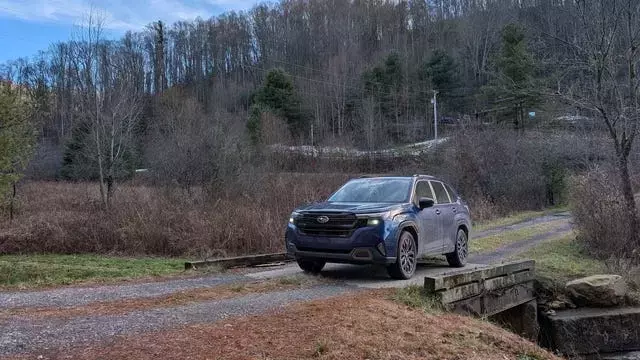
Long-Term Review: 2025 Subaru Forester Sport Performance & Ownership
Car and Driver's extensive 40,000-mile long-term evaluation of the 2025 Subaru Forester Sport underscores its identity as a practical, comfortable, and dependable compact SUV, albeit one that doesn't prioritize thrilling driving dynamics or advanced technological integration. Introduced with an appealing price point significantly below the market average for new vehicles, the Forester aimed to offer solid value. Over 17 months, the vehicle demonstrated consistent performance in daily commutes and extended road trips, proving its utility as a family hauler. However, testers frequently noted the slow response of its infotainment system and the modest power output from its 2.5-liter engine, which contrasted with its otherwise agreeable ride quality and practical interior design. Despite minor issues like a cracked windshield and brake wear, the Forester maintained a commendable record for reliability and low service costs, largely covered by warranty, making it a sensible choice for budget-conscious buyers seeking a steadfast companion.
When the 2025 Subaru Forester Sport joined the Car and Driver long-term fleet in early 2025, it stood out with an as-tested price of $37,730, significantly below the new vehicle average of $47,462 at the time. This affordability became even more pertinent as average transaction prices approached $50,000, reinforcing the team's objective to evaluate a car accessible to a broader economic spectrum. The sixth-generation Forester boasts an appealing aesthetic, particularly in its distinctive blue-and-bronze color scheme. Inside, the cabin impresses with quality materials and user-friendly physical controls, a welcome departure from the increasing trend of capacitive digital interfaces in the automotive industry.
Despite its practical strengths, the Forester's infotainment system was a persistent source of frustration. Testers frequently documented its sluggish responsiveness, especially when starting up in colder weather, often taking up to 10 seconds for initial inputs to register. This delay, though improving after a few minutes of driving, remained a constant irritant throughout the testing period. Similarly, the 2.5-liter flat-four engine, producing 180 horsepower and 178 pound-feet of torque via a continuously variable automatic transmission, drew criticism for its uninspiring acceleration. While it eventually improved slightly in 0-60 mph times compared to its hybrid counterpart, it remained one of the slower options in its segment.
A notable aspect of the Forester's long-term journey was a winter adventure to Eagle River, Wisconsin, for an ice driving course. This experience, undertaken at Ice Driving USA, allowed testers to explore the vehicle's capabilities on frozen surfaces. Initially, with standard Bridgestone Blizzak WS90 winter tires, the Forester performed surprisingly well, demonstrating a fun degree of rotation in slaloms and Scandi-flicks, even with partially enabled stability control. The experience took a dramatic turn on the second day with the installation of Lappi studded winter tires, each equipped with 520 studs. The enhanced grip transformed the Forester, making it feel exhilarating on ice, despite the stability control system slightly hampering true rally-car dynamics. This segment highlighted an unexpected and enjoyable facet of the Forester's character, particularly its sure-footedness in extreme winter conditions.
Back in regular driving conditions, staff logbook entries revealed ongoing minor complaints. Noise levels, particularly the "tin can" cabin acoustics and the "howl" from the Blizzak winter tires at highway speeds, were frequently mentioned. The precise steering was also a point of desired improvement. Additionally, the driver-assistance systems, specifically Subaru's EyeSight, drew criticism for incessant beeping warnings, particularly when adaptive cruise control was active or when straying slightly within a lane. Despite these grievances, the Forester consistently proved its reliability, with maintenance visits being routine and covered under Subaru's complimentary maintenance plan. A loose driver's-side door hinge, causing a creak, was easily fixed, and warped brake rotors were replaced under warranty after an ice driving incident, showcasing its generally dependable nature.
Throughout its evaluation, the 2025 Subaru Forester Sport emerged as a highly practical and reliable vehicle, ideal for everyday commuting, family duties, and light adventure. Its comfortable seating, excellent visibility, and compliant suspension system make it well-suited for varied road conditions, including rough pavement. While it may not offer an engaging driving experience or the most advanced infotainment technology, its consistent performance, spacious interior, and commendable long-term reliability underscore its value. The Forester's ability to handle diverse needs, from grocery runs to challenging winter terrains, confirms its position as a solid, if not thrilling, choice for those seeking a dependable and affordable SUV.