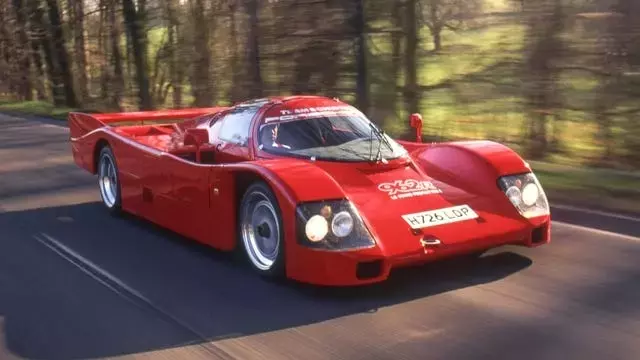
The Road-Legal Porsche 962CR: A Race Car for the Streets
Vern Schuppan, an acclaimed Le Mans winner, has embarked on an ambitious endeavor: transforming the legendary Porsche 962 race car into a street-legal marvel. This exclusive vehicle, dubbed the 962CR, offers a rare opportunity for enthusiasts to command a high-performance machine on public roads, albeit at a premium price of $1.62 million. While its racing pedigree demands certain concessions for road use, such as noise reduction and emission controls, the essence of a 600-horsepower Group C car remains. This project underscores the passion for pushing automotive boundaries, offering a select few the thrill of a race car experience in an entirely new context.
The Birth of a Road-Going Legend: Vern Schuppan's Porsche 962CR
In a bold move that captured the imagination of automotive aficionados, former Le Mans champion Vern Schuppan unveiled plans in July 1991 to produce a street-legal iteration of the Porsche 962. This groundbreaking project aims to deliver a 600-horsepower, Porsche-derived racing machine, known as the 962CR, to the affluent and adventurous. With a price tag of $1.62 million, only 50 units are slated for production worldwide, with a mere 17 designated for the United States, ensuring its exclusivity.
Schuppan, an Australian racing icon with a formidable resume that includes a Le Mans victory in 1983 and an Indianapolis 500 bronze medal in 1981, is leading this extraordinary venture. The nomenclature “CR” signifies its Group C racing origins and its adaptation for road use. Unlike its pure racing counterparts, the 962CR will feature unique “GT” bodywork and creature comforts commensurate with its lavish price. The prototype for these road-going rockets, a genuine Stuttgart-built 962 (chassis number 962/123), had a storied racing history with the Primus team in IMSA and later competed at Le Mans in 1988, finishing an impressive tenth. This very car, retired after the Fuji 1000-kilometer race, became the foundation for Schuppan's ambitious road car project.
The modifications for road legality were extensive, primarily focusing on the engine. The original 24-valve, twin-turbo 2.6-liter flat-6 engine, with its water-cooled cylinder heads, needed to be adapted to meet contemporary emissions and noise regulations. This involved the integration of a full three-way catalytic converter system, essential for compliance in both the U.S. and Japan. Despite these alterations, the engineering team managed to maintain the engine's formidable 680 horsepower output. Addressing potential overheating issues in traffic, two large electric fans were discreetly added beneath the side sponsons, which already housed the water and oil radiators and turbo intercoolers. Furthermore, the cramped cockpit, devoid of opening windows, necessitated the installation of a Sanden air conditioning system, cleverly tucked into the chassis below the passenger door.
The car's exhaust system, initially featuring an undersized single muffler, was augmented with two additional mufflers to meet noise standards. While the interior remains a testament to its racing heritage, with the mechanical symphony of camshafts and valve gear, the 962CR promises a somewhat quieter experience than its purebred track sibling. The production models will boast Schuppan's custom carbon-fiber monocoque chassis and carbon-fiber and Kevlar bodywork, a significant upgrade from the original Porsche panels, predominantly made of fiberglass.
Driving the 962CR presents a unique blend of exhilaration and challenge. The stiff, single-plate racing clutch demands precise operation, while the five-speed gearbox, though equipped with synchromesh, requires a deliberate effort to engage first gear. The braking system, featuring massive Alcon calipers, provides immense stopping power, and the steering, surprisingly light at cruising speeds, offers a direct and responsive feel, albeit requiring a delicate touch due to its quick lock-to-lock ratio. Navigating bustling English country lanes proved a compelling experience, highlighting the car's imposing size and its ability to command attention. Although the reporters managed only 120 mph on public roads, the car's true potential, exceeding 215 mph with optimal gearing and turbo boost, remains undeniable.
Schuppan's vision extends beyond mere road legality; he aims to provide owners with a vehicle capable of transitioning seamlessly from street to track. This involves allowing owners to install stiffer springs, lower the ride height, and equip racing slicks for track days. He even contemplates entering a 962CR in the grueling Daytona 24 Hours, a testament to the car's dual-purpose design. Located in High Wycombe, England, Schuppan's operation has expanded to manage this transition from racing to exclusive road car manufacturing, producing approximately one vehicle per month. With key appointments like Ray Borrett, former head of prototypes at Holden, the venture is well-equipped to deliver on its promise. At the time of its announcement, the 962CR was poised to precede other contenders like the Jaguar XJ220 and McLaren F1, potentially claiming the title of the fastest truly street-legal car in the world, and certainly the most expensive.
The journey of transforming a formidable Le Mans racer into a road-legal supercar is not merely an engineering feat; it's a profound statement about passion, precision, and the relentless pursuit of automotive excellence. The 962CR, born from the track and tamed for the street, embodies a unique blend of heritage and innovation. It reminds us that for some, the thrill of driving is not confined to the race circuit, but extends to the open road, where the roar of a potent engine and the precision of race-bred mechanics can be experienced, albeit with a necessary degree of discretion. This endeavor inspires us to dream bigger, pushing the boundaries of what's possible, and reminding us that true automotive artistry lies in creating machines that stir the soul, whether on the track or the boulevard.